
The Quantum Valley
What changed on the Front Range, what it taught us, and a small gift for the people who build it

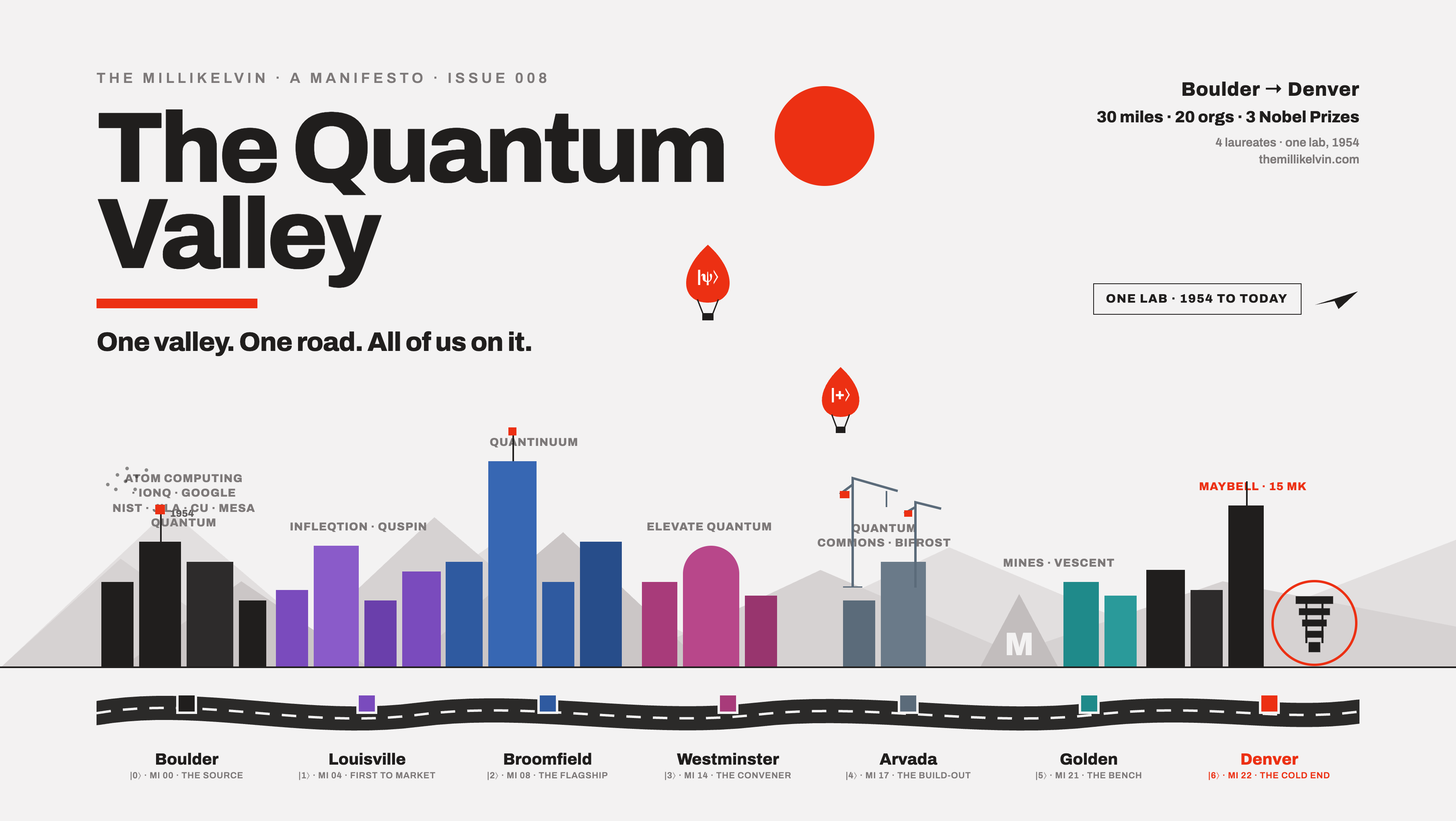
Today the doors are open. The Deep has been for paying readers all season. This one is for everyone, because it is the piece where we look up from the filings, take in the whole corridor at once, and thank the people who build it.
If you are new here, one orientation before we start. We cover a single thirty-mile line of the Front Range, from NIST Boulder up against the Flatirons down to Maybell’s dilution refrigerators on the Denver plain. Boulder sits higher; Denver sits lower and colder in the stack; everything in between runs downhill like snowmelt off the foothills. We drive past these buildings. That proximity is the whole beat, and it is why no publication anywhere else can report this cluster the way we can.
We started a few months ago thinking we were sketching something fixed, a cluster that had been settled here since the Nobel Prizes. We were wrong about fixed. In one season the valley moved more than a decades-old ecosystem has any right to. Here is what shifted, what it taught us, a plain field guide to what this place actually is, and one small thing we made to mark the season.
The headwater
Start at the source, because everything downstream is measured against it.
On June 5, 1995, in a basement lab on the CU Boulder campus, Eric Cornell and Carl Wieman cooled about two thousand rubidium-87 atoms to 170 billionths of a degree above absolute zero and watched them stop behaving like separate atoms. They became one thing, a Bose-Einstein condensate, predicted by Einstein and Satyendra Nath Bose in 1925 and unseen for seventy years. Mind the temperature. We are named for the millikelvin, thousandths of a degree above absolute zero, where a dilution refrigerator runs and most quantum hardware lives. Cornell and Wieman went about six thousand times colder. The Nobel came six years later.
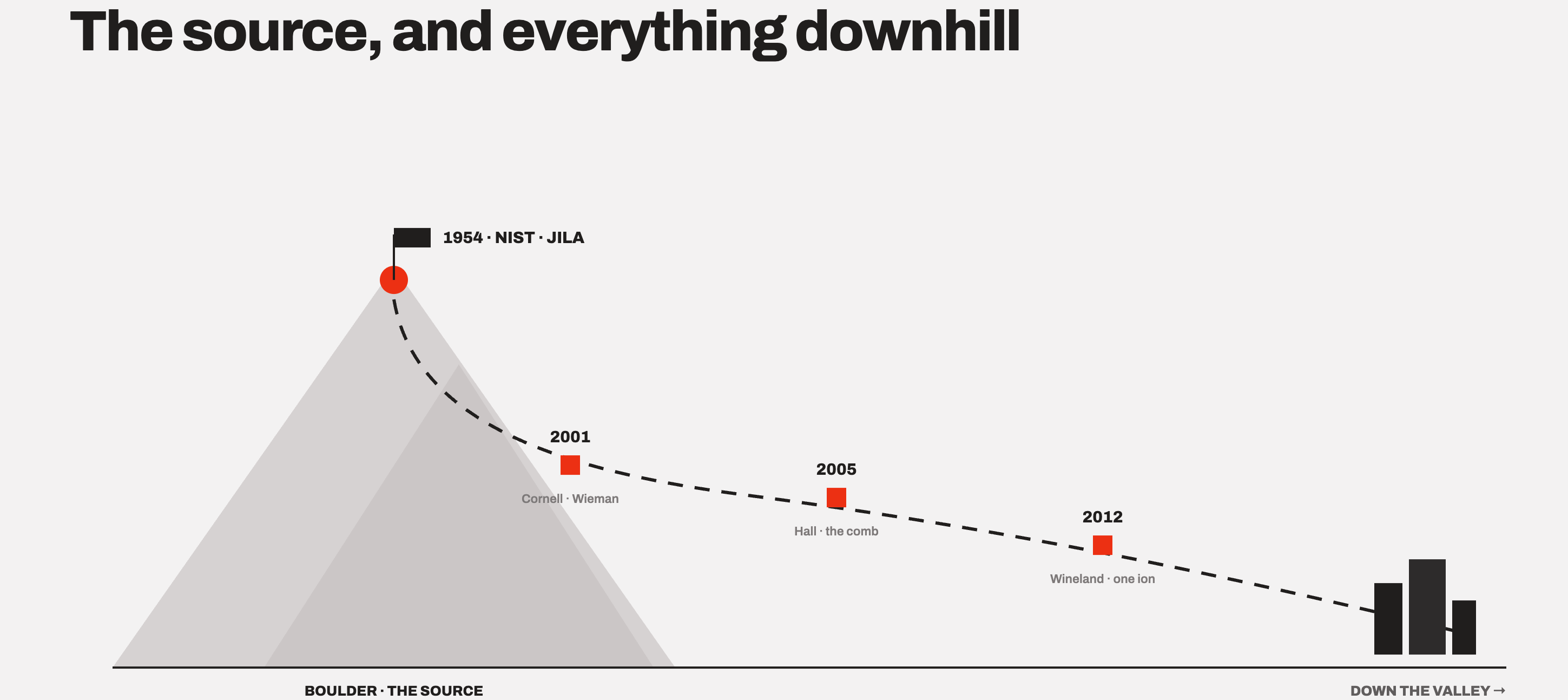
That morning is the headwater, and it has not moved. In 1954 the National Bureau of Standards opened a measurement lab at the foot of the Flatirons. It became NIST in 1988; in 1962 NIST and CU Boulder founded JILA, and atomic, molecular and optical physics got itself an American capital. We opened this whole run there, in our NIST Boulder Deep. Three Nobel Prizes came off that campus. Cornell and Wieman in 2001 for the condensate. Jan Hall in 2005 for the optical frequency comb, the laser ruler the whole field now measures with. David Wineland in 2012 for holding a single ion still enough to command it. Four laureates, one federal building, and a rule that explains the entire map: the physics was here first, the people stayed, and the companies ran downhill from them. Cold atoms became Infleqtion in Louisville. Trapped ions became Quantinuum’s architecture in Broomfield. Hall’s comb became Vescent, Octave, and LongPath. Ben Bloom, out of CU Boulder, founded Atom Computing. The science ran off the mountain and turned into machines.
That much you could have written a year ago. Now the part you could not.
What moved while we watched
Set the clock at the start of our run and count the jumps, because in this valley progress does not creep, it jumps.
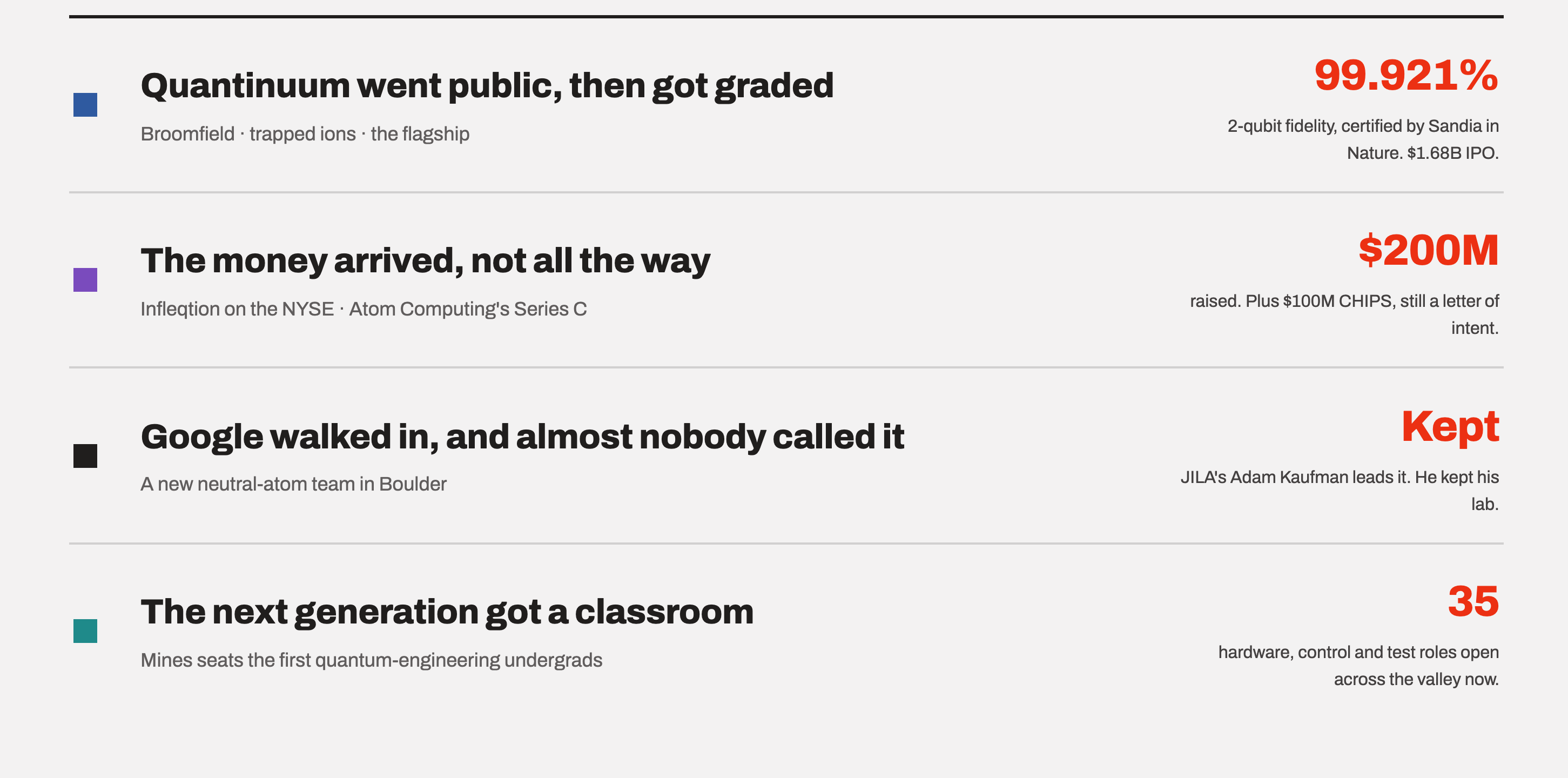
None of that stood in this form when we began. A cluster the world calls decades old rewrote a real part of itself in a single season. That was the first surprise.
A field guide: who actually builds what
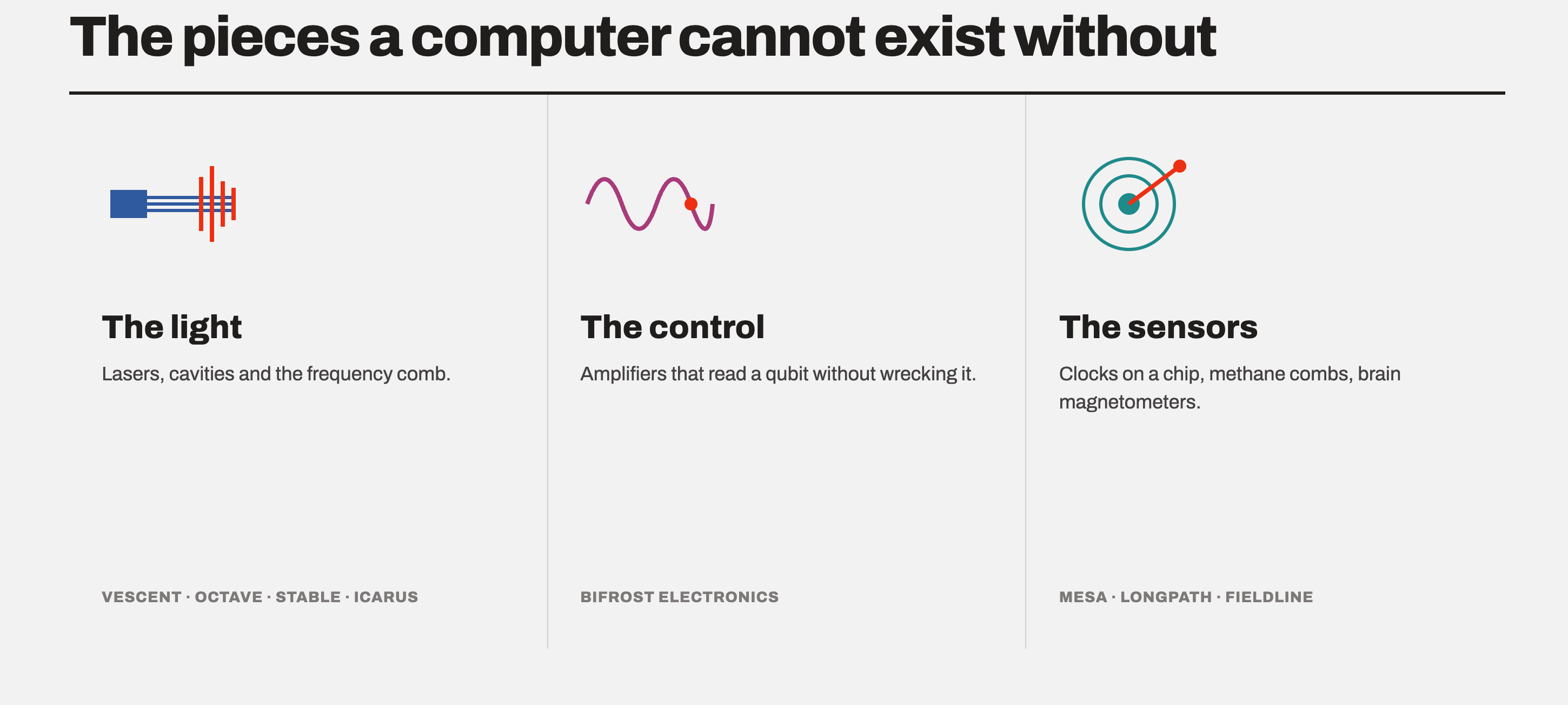
The second surprise was about our own map, and this is the most useful page we can hand a new reader, so keep it. Ask the trade press and Colorado has five quantum computing companies: Quantinuum, Atom Computing, Infleqtion, IonQ’s Boulder lab, and now Google. True, and the smaller half of the story. Sort the corridor by layer, the way a builder would. Five names build the computers. Ten build the parts the computers are made from. Here is the bench, plainly, so you know who is who when the news names them.
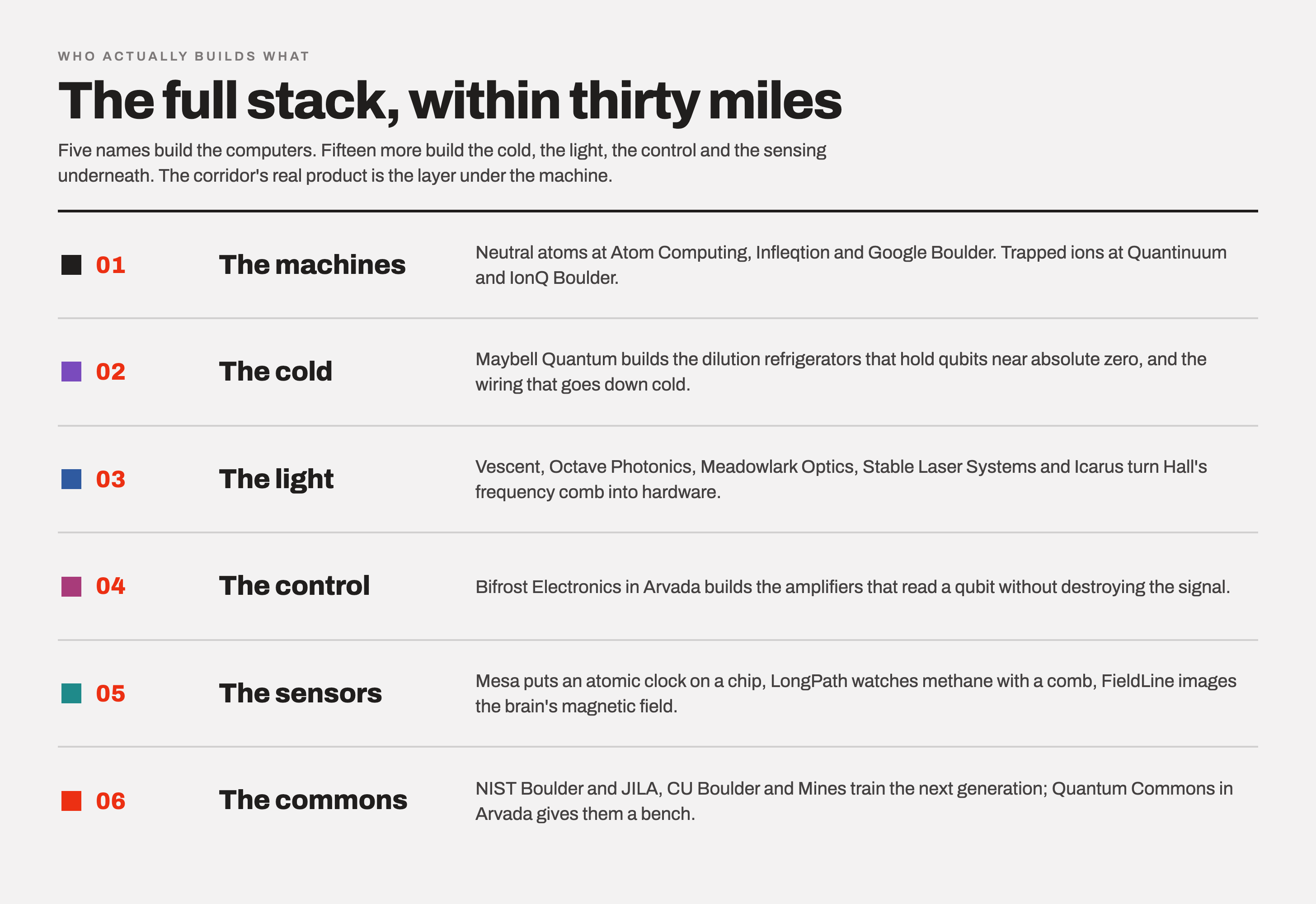
Hold the takeaway, because it is the single most useful thing we learned all season: the corridor’s real product is not the machine. It is the cold, the light, and the control that sit under the machine, and two thirds of the companies with a product live down there. We did not see that clearly on day one. Reporting it, filing by filing, is what taught it to us. The biggest thing that changed over the run was our own picture of what this place is.
The whole run, in one place
If you are new today, here is the season, so you can read any name on the map in full. Each Deep is one company, one person, one moment, reported end to end. The companion pages are always free.
Before the physics, where we began, an opening edition on why a valley, and not a scatter of startups.
Then the run.
Deep 001 · NIST Boulder and JILA, the source, where the lineage starts, with the free lineage tree.
Deep 002 · Maybell and Corban Tillemann-Dick, the infrastructure bet, why the cold layer may outlast any single qubit, with the free companion The Stack, the whole valley laid out top to bottom.
Deep 003 · Atom Computing, Ben Bloom and neutral-atom error correction, and its companion.
Deep 004 · Infleqtion, Matt Kinsella and the sensing bet hiding under the computer, and its companion.
Deep 005 · Quantinuum, the IPO and the fidelity gap, and its companion.
Deep 006 · Elevate Quantum, Jessi Olsen and how a Tech Hub of rivals actually works, with the free companion Front Range map.
Deep 007 · Google Quantum AI Boulder, Adam Kaufman and the word that got skipped, “kept,” and its companion.
And one edition on the clock the whole field is racing: The Pentagon set a 2030 deadline, the federal timeline every roadmap on this map is measured against.
The people are the point, not the prizes: Eric Cornell and Carl Wieman, Jan Hall, and David Wineland, the four laureates; Adam Kaufman and Ben Bloom, who carried JILA into industry; Chris Myatt, the cleanest Wineland-and-Wieman double lineage in the cluster; and Kelly Schilling, the Maybell technician who assembles a refrigerator by hand and reminds us who actually builds the cold. Every link above leads back to one of them.
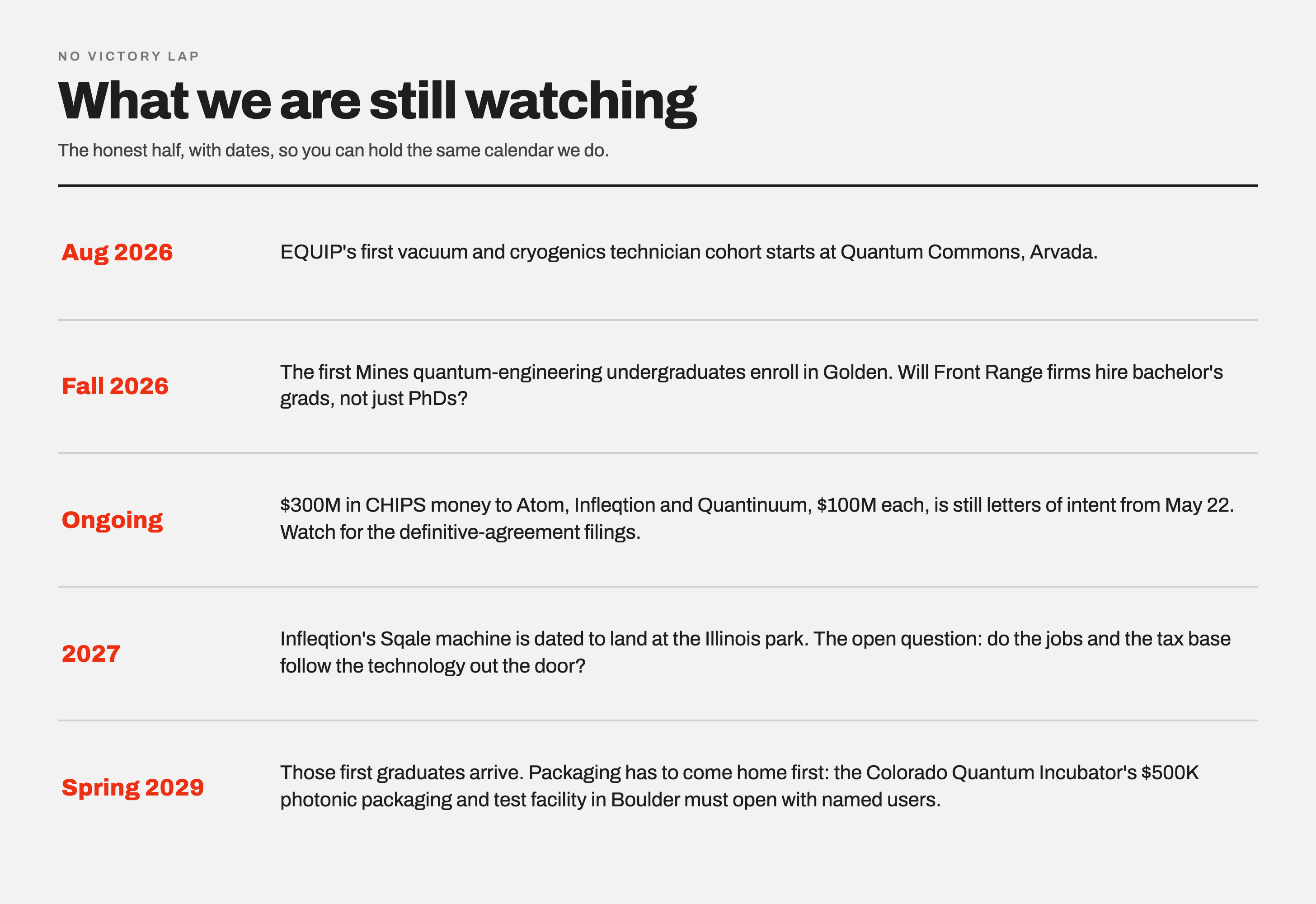
Next: the second layer
Here is our commitment for what comes back after this batch.
A small gift for the road
Which brings us to the thing we made for you.
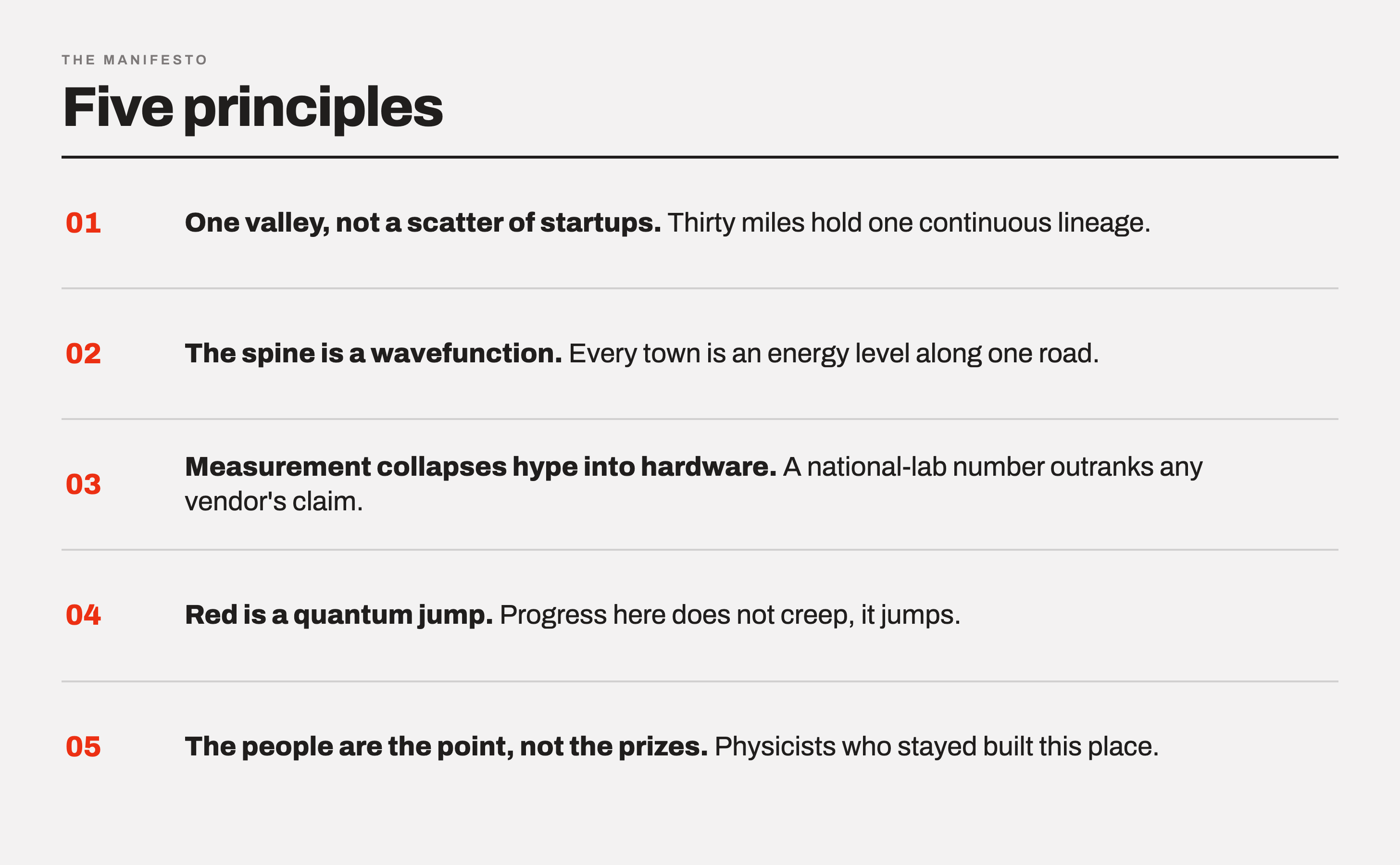
Alongside this piece we published a manifesto: the whole valley on one page, thirty miles read as a single line from the source in Boulder to the cold end in Denver, every layer of the stack on one horizon. At the top is a wallpaper generator. Pick your screen, pick the company you work at, pick a finish, and download the valley skyline at your display’s exact resolution, drawn to the pixel, so it fits a 4K desktop or a phone lock screen.
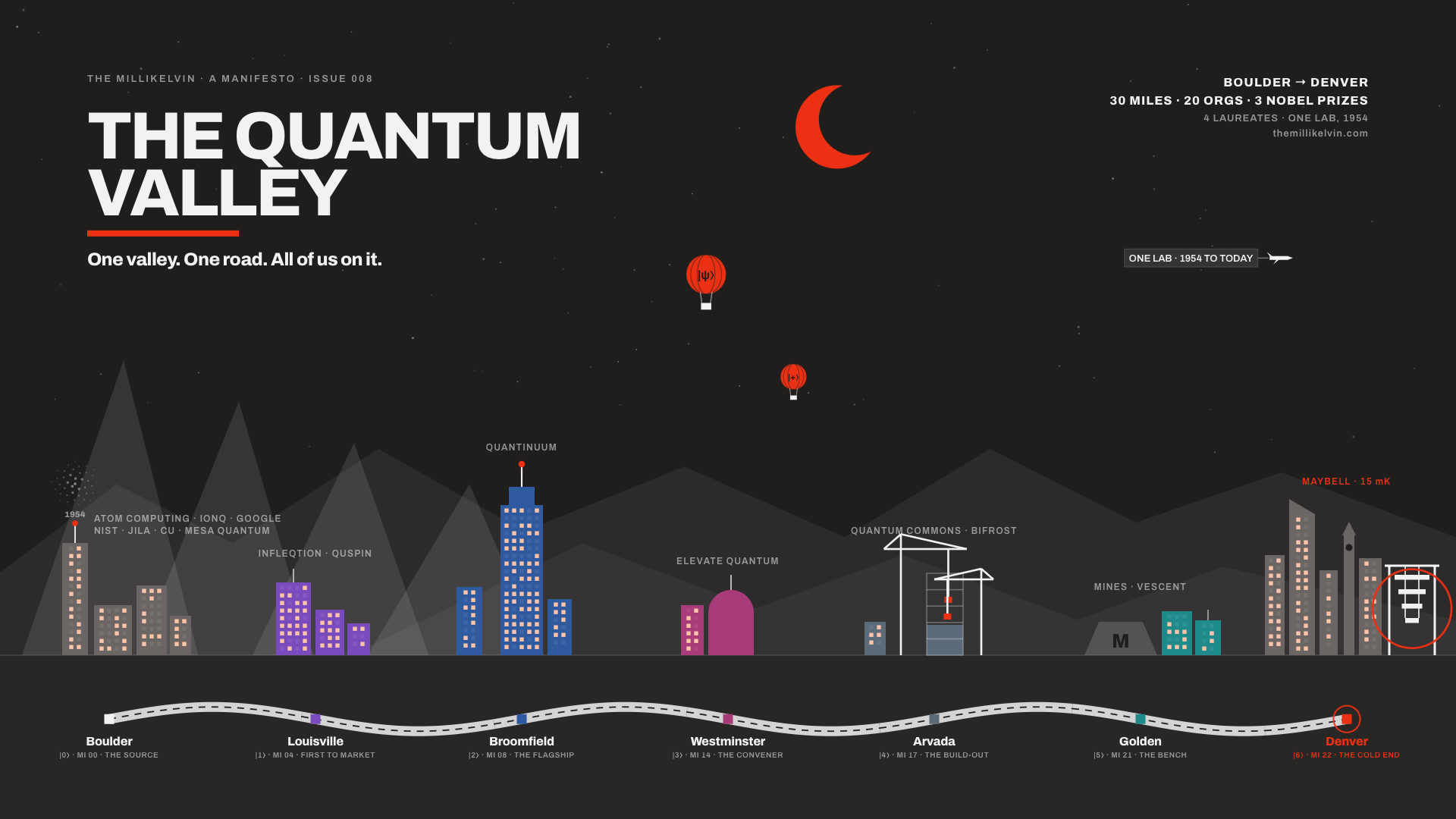
If this corridor inspires you the way it has inspired us, that is the entire point. The manifesto says out loud what a season of reporting kept quietly proving: one federal lab in 1954, and seventy years of people who chose to stay put at the foot of the mountains, made a place unlike anywhere else in America. We wanted to hand that back to the community in a form you could keep.
And because a beat this serious deserves to be enjoyed too, here is the fun we made on the way, all free. The Quantum Zodiac, where we sorted the Nasdaq-100 by which qubit each company would be if it were made of physics. The Daily Gate, a small piece of the field to turn over each morning. And Everyday Quantum, the physics of this valley translated into the objects already in your pocket. Play with them. They are our way of saying this stuff is yours too, not only the specialists’.
Not goodbye
This is the last Deep of this batch, not the last Deep. The season closes here; the reporting catches its breath and comes back to the second layer. The Signal still lands on Tuesdays. The dossiers keep growing. The map stays live at themillikelvin.com, wallpaper and all, and it is incomplete in some way we have not found yet. When you find it, tell us, and we will fix it in the open.
If the doors being open is how you got here, welcome. Read back through the archive; it is a season of one thirty-mile corridor told straight, company by company. Then look up from the screen, because the valley it describes is a real place, thirty miles of patient, precise, quietly extraordinary work, and it is getting longer.
Thank you for reading this season. We will see you for the next one.